

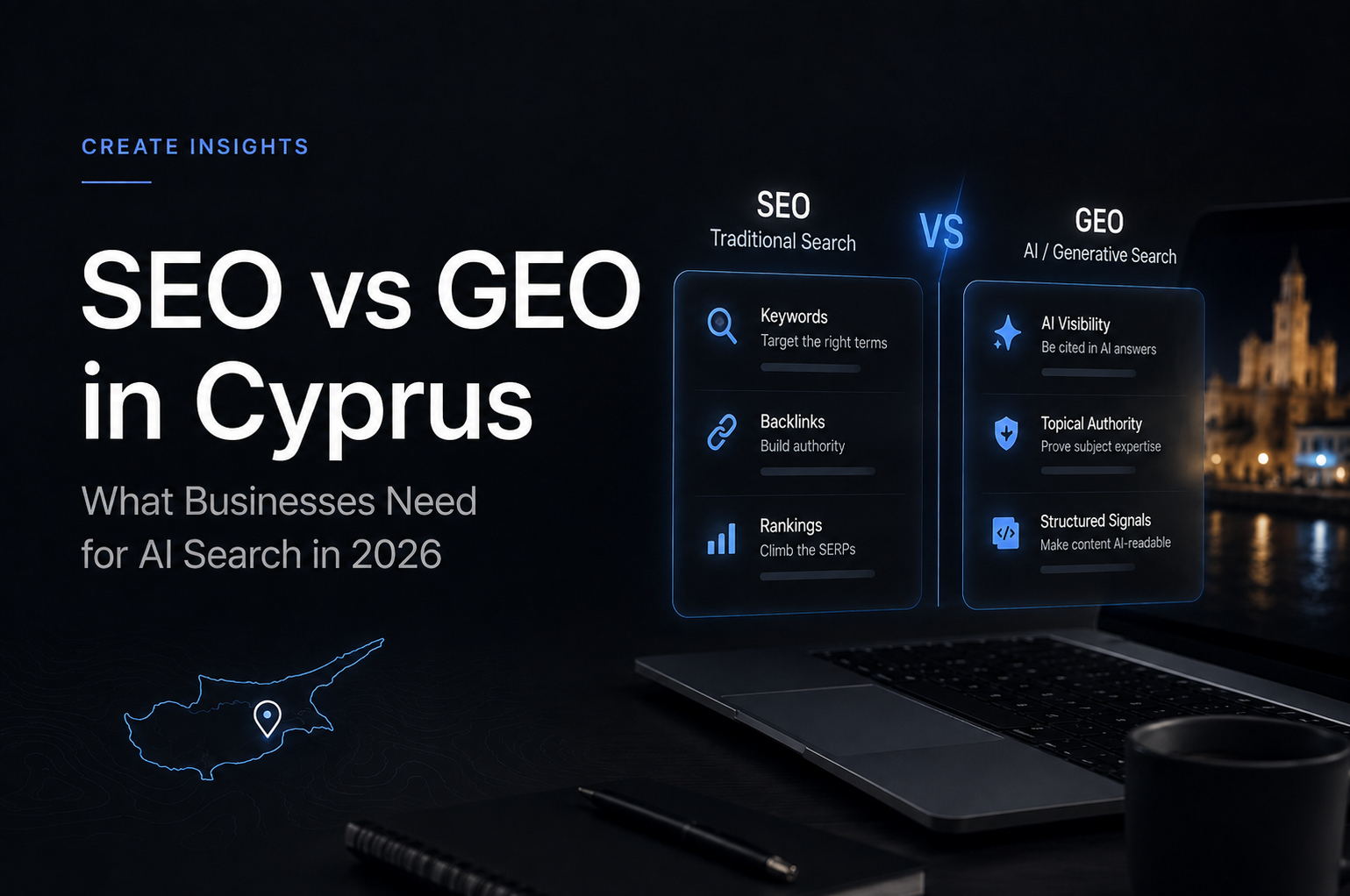
Quick answer: SEO and GEO are not competing strategies. SEO builds the technical, content and authority foundations that search engines use to understand and rank a website. GEO, or Generative Engine Optimization, is an industry term for improving visibility in AI-generated answers. In 2026, the strongest approach for Cyprus businesses is to treat GEO as an extension of serious SEO rather than a replacement for it.
AI search has changed the interface through which people discover businesses. Traditional search may return ten links. A generative system may answer a complex question directly, cite several sources and recommend a smaller set of businesses. That changes how visibility is measured, but it does not make the underlying website, authority and content fundamentals disappear.
What is SEO?
SEO, or Search Engine Optimization, is the process of improving a website so that search engines can crawl it, understand it and surface it for relevant queries. Good SEO includes technical accessibility, information architecture, content, internal linking, backlinks and mentions, local signals, page experience and measurement.
For a Cyprus business, SEO might mean ranking a service page for a commercially relevant search, appearing for local intent, earning visibility through a specialist article or building an authoritative topic cluster around a profitable market.
What is GEO?
GEO stands for Generative Engine Optimization. It is commonly used to describe work intended to improve how a brand or website appears in generative systems such as AI search results, AI summaries and conversational answer engines.
Related terms include AEO, or Answer Engine Optimization, and LLMO, or Large Language Model Optimization. The terminology is still evolving, and different agencies use the labels differently.
The important point is that the label is less important than the implementation. If a GEO strategy ignores crawlability, site quality, content usefulness and authority, it is unlikely to be durable.
What does Google say about SEO vs GEO?
Google’s 2026 guidance is unusually clear. It says that the best practices for SEO continue to be relevant to generative AI features such as AI Overviews and AI Mode because those experiences are rooted in Google’s core Search ranking and quality systems.
Google also addresses the terminology directly: from its perspective, optimizing for generative AI search is still optimizing for Search. It recommends focusing on useful, unique content and established SEO fundamentals rather than treating AEO or GEO as a separate set of hacks.
You can read Google’s official guide to optimizing for generative AI features.
SEO vs GEO: the practical differences
| Area | Traditional SEO focus | Generative / GEO focus |
|---|---|---|
| Primary visibility | Search rankings and rich results | Citations, links, mentions and inclusion in AI answers |
| Query style | Keywords and search phrases | Conversational, multi-part questions |
| Content strategy | Pages targeting search intent | Pages that also provide extractable, well-supported answers and evidence |
| Authority | Links, brand signals and relevance | Same foundations plus a wider source landscape that may be consulted in an AI answer |
| Measurement | Impressions, clicks, rankings and conversions | AI citations, referral traffic, generative impressions where available and conversions |
| Technical foundation | Crawlability, indexability and page quality | Still crawlability, accessibility and reliable page structure |
The biggest difference is therefore the surface on which visibility appears. The fundamentals overlap heavily.
Why AI search makes topic depth more important
Google describes a technique called query fan-out, where its AI systems may generate several related searches to understand a complex question. This means a useful topic cluster can be more valuable than a single page obsessively optimized for one exact keyword.
For example, a property developer researching marketing may ask one broad question, but an AI system could explore related topics such as SEO, paid advertising, landing pages, lead qualification, international buyers and CRM follow-up. A website with credible content across those connected areas has a richer evidence base.
This is why Create has built a connected real-estate content cluster including SEO for Property Developers in Cyprus, Content Marketing for Property Developers and a Square One case study.
What should change in an SEO strategy for AI search?
Prioritize original evidence
Commodity content is increasingly easy to replicate. Original project data, real examples, screenshots, expert analysis and local observations are more defensible. Google explicitly highlights non-commodity content in its generative AI guidance.
Answer complex questions clearly
Strong pages should make it easy for a reader to locate a direct answer while still providing depth. Clear headings, concise explanations and supporting evidence improve usability for humans and make the page easier to interpret.
Build entities, not only keyword pages
A business should be consistently associated with the services, locations, people, industries and expertise it actually represents. That means clear About information, service architecture, case studies, local context and credible third-party references.
Strengthen cross-channel evidence
An AI system searching the web may encounter your website alongside reviews, directories, news, partner references and other independent sources. A coherent public footprint is more useful than isolated on-site claims.
Measure new discovery paths
Traditional SEO reporting should be expanded rather than replaced. Track ChatGPT referrals, AI-search landing pages and, where available, Google’s generative AI performance reporting alongside Search Console, GA4 and conversion data.
What should not change?
Several fundamentals remain essential:
- fast, crawlable pages;
- clear site architecture;
- useful service pages;
- strong internal linking;
- accurate canonical and indexing signals;
- local and entity consistency;
- helpful content written for real users;
- credible authority signals;
- conversion tracking.
If a provider proposes a “GEO package” that ignores those basics, the strategy is incomplete.
Does structured data matter for GEO?
Structured data is still useful when it accurately represents visible content and supports normal Search features. However, Google states there is no special schema markup required for its generative AI features.
This is an important distinction. Structured data can improve machine-readable clarity, but it should not be presented as an AI-ranking guarantee.
What about llms.txt?
Some websites have added an llms.txt file to provide LLM-oriented guidance. Google’s current position is that it ignores llms.txt for Search, meaning the file neither helps nor harms Google rankings or generative AI visibility.
Other services may adopt their own standards, so the file can still exist for other reasons. The problem begins when it is marketed as a universal GEO shortcut.
SEO vs GEO for a Cyprus business: where should the budget go?
For most Cyprus businesses, the sensible order is:
- Fix the website foundation. Ensure the site is crawlable, fast, logically structured and conversion-ready.
- Strengthen commercial pages. Build authoritative pages around the services that generate revenue.
- Develop topical authority. Publish genuinely useful supporting content rather than thin keyword variations.
- Add first-party proof. Case studies and original data make the site harder to substitute.
- Improve external authority. Build a credible public footprint through legitimate mentions, partnerships and reviews.
- Audit AI discovery. Check ChatGPT Search accessibility, generative visibility and referral traffic.
This sequence produces benefits for both conventional search and AI discovery instead of funding a separate “AI layer” on top of a weak website.
Common GEO myths in 2026
“SEO is dead because people use AI now.”
False. Google’s own generative AI systems rely on core Search systems, and ChatGPT Search still depends on discoverable web information. Search behavior is evolving, not eliminating the web.
“You need a separate page for every AI prompt.”
No. Google warns against scaled content created primarily to capture variations. A strong page can answer a topic comprehensively without spawning dozens of near-duplicates.
“Special AI schema guarantees citations.”
No. There is no documented universal AI schema that guarantees inclusion.
“Mentions are the new backlinks, so buy as many as possible.”
That is an oversimplification. Genuine third-party evidence can be valuable, but manufactured mentions and spam remain poor long-term strategy.
How SEO and GEO work together at Create
Our approach is to treat AI visibility as an additional discovery layer within a broader search and website system. That means starting with technical SEO, information architecture and useful content, then strengthening first-party evidence, local relevance, external signals and analytics.
The same principle is visible in the underlying systems built for projects such as Golden Oak Private School: website architecture, search visibility, structured admissions journeys and measurement work together. AI visibility is strongest when those foundations already exist.
Frequently asked questions
Is GEO a real discipline?
It is a real industry term describing work focused on generative search visibility. However, there is no universal standard for what a GEO service includes, so businesses should evaluate the actual methodology rather than the label.
Should I hire a GEO agency or an SEO agency?
Choose a provider that understands both. A capable strategy should cover technical search foundations, content, authority, AI discovery, measurement and conversion rather than treating AI visibility as an isolated tactic.
Does ChatGPT use Google rankings?
OpenAI does not publish a simple formula equating ChatGPT Search results with Google rankings. ChatGPT Search can use web search and other providers, so strong web visibility helps, but there is no one-to-one ranking relationship.
Can GEO guarantee my business gets recommended?
No. Generative answers are dynamic and no credible agency can guarantee a fixed organic recommendation. The realistic objective is to improve the quality and discoverability of the evidence supporting your business.
Which should a small business prioritize first?
Start with the fundamentals: a technically sound website, strong service pages, useful local content, credible proof and tracking. These assets support both SEO and generative discovery.
Build for search, not for acronyms
The strongest 2026 strategy is not SEO or GEO. It is a high-quality search ecosystem that works across conventional results and generative interfaces.
For the full implementation framework, read AI Visibility in Cyprus. To assess how accessible your website is to ChatGPT specifically, see How to Get Your Business Found on ChatGPT in Cyprus, or explore our SEO & AI Visibility service.
If you want Create to review your current search architecture and identify practical AI-visibility opportunities, request a quote.