

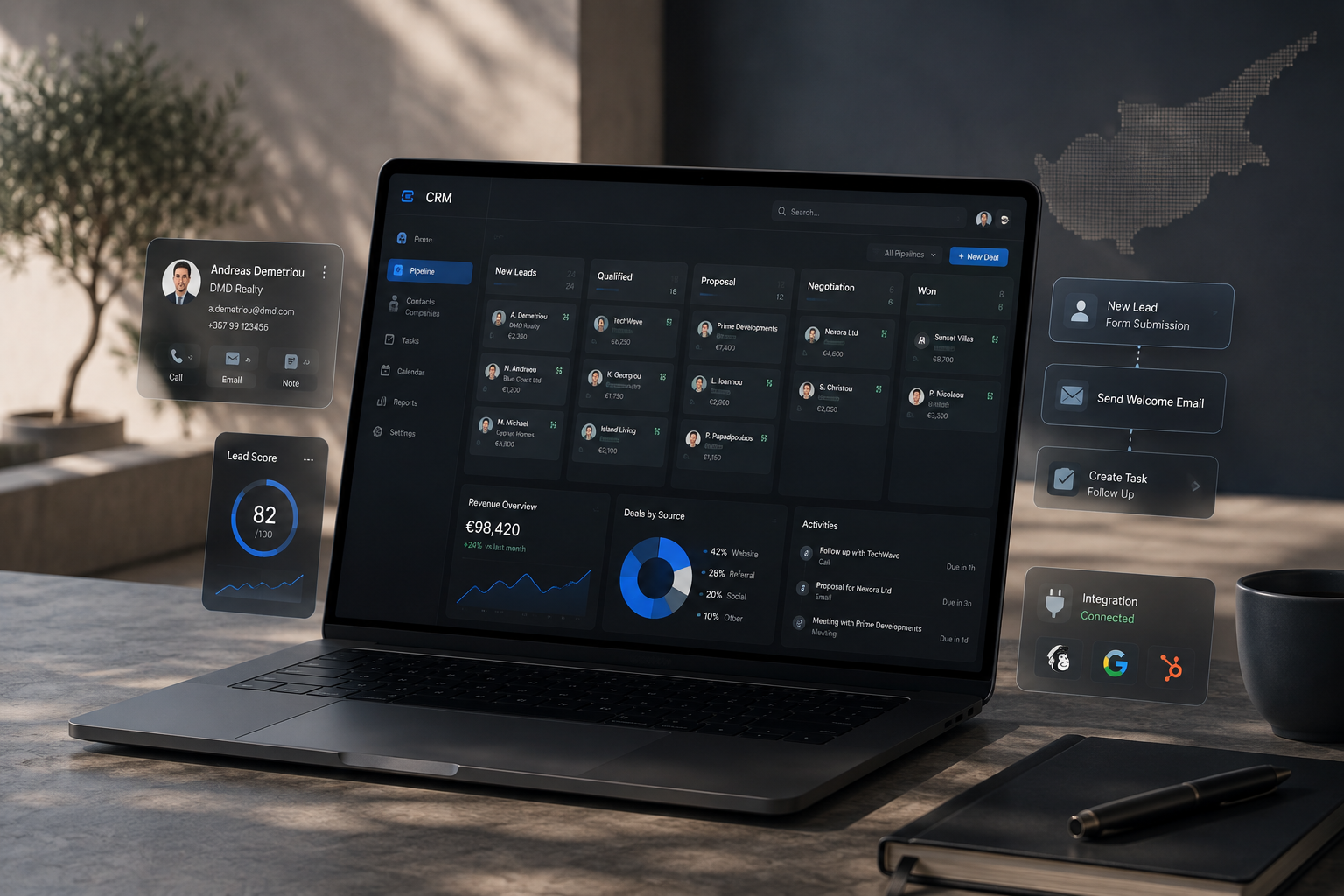
Quick answer: A CRM system gives a business one place to capture enquiries, organise contacts, manage follow-up, track sales opportunities and measure what happens after a lead comes in. For Cyprus businesses investing in websites, SEO, Google Ads or Meta Ads, the CRM is the operational layer that connects marketing activity to an actual sales process.
Many companies reach a point where inboxes, spreadsheets, WhatsApp messages and individual notes are no longer enough. Leads arrive from several channels, more than one person may be involved in follow-up, and management needs clearer visibility over what is moving forward. That is where a properly configured CRM becomes valuable.
What is a CRM system?
CRM stands for customer relationship management. In practice, a CRM system is software that stores customer and prospect information while recording the activity around each relationship.
Instead of keeping lead data across separate tools, a CRM can bring together:
- contact and company records;
- lead sources and campaign information;
- sales pipelines and deal stages;
- calls, emails, meetings and notes;
- follow-up tasks and reminders;
- workflow automation;
- sales and lead reporting.
The objective is not simply to store contacts. A useful CRM should make the sales process easier to understand and harder to neglect.
Why CRM systems matter for Cyprus businesses
A small number of enquiries can often be managed manually. The problems become more obvious as the business grows or begins generating leads from several channels at once.
Missed enquiries
If website forms, advertising leads, emails and direct messages are handled separately, there is no single view of the sales pipeline. A CRM reduces the risk of opportunities being forgotten or duplicated.
Slow or inconsistent follow-up
A strong lead can lose value quickly if nobody knows who should respond or when the next action is due. CRM tasks, ownership and reminders create a more disciplined follow-up process.
Poor lead-source visibility
If a business is investing in SEO, Google Ads, Meta Ads and other channels, it should be able to identify where enquiries came from and what happened afterwards. Source tracking inside the CRM helps connect acquisition activity with the sales pipeline.
Unclear sales reporting
Without a central system, management may know how many enquiries arrived but not how many were contacted, qualified, quoted or converted. A CRM makes those stages measurable.
Core CRM features a business should consider
Lead capture
Website and landing-page forms should be able to create or update CRM records automatically. This reduces manual data entry and gives every enquiry a consistent starting point.
Sales pipeline management
A pipeline turns the sales process into defined stages. A simple service-business pipeline might include New Enquiry, Contacted, Qualified, Proposal Sent, Negotiation, Won and Lost. Other industries need different stages.
Tasks and ownership
Each active opportunity should have a clear owner and next action. Tasks, reminders and activity history make it easier for teams to coordinate without relying on memory.
Automation
Useful automation can include internal notifications, confirmation emails, lead assignment, task creation, follow-up reminders and status changes. The best workflows remove repetitive admin without making the customer experience feel robotic.
Integrations
The CRM should connect sensibly with the rest of the business stack. Depending on the setup, that can include the website, email, advertising platforms, calendars, form tools, analytics and reporting systems.
Reporting
Useful reports can show new leads, lead sources, pipeline value, conversion by stage, sales activity and closed outcomes. The exact reporting model should match what the business actually needs to manage.
Which businesses benefit most from a CRM?
Any company that manages ongoing enquiries can benefit, but CRM systems are particularly useful when the sale is not instantaneous.
- Real estate developers and agencies: manage project interest, buyer qualification, viewings, proposals and reservations.
- Schools and education providers: structure admissions enquiries, document follow-up and application stages.
- Healthcare and professional services: organise commercial enquiries and non-clinical lead follow-up while maintaining appropriate data-handling practices.
- B2B and service businesses: manage consultations, quotations, proposals and longer sales cycles.
- Marketing-led businesses: connect paid and organic lead generation to a measurable sales process.
How to choose the right CRM
There is no universal best CRM. The correct platform depends on how the business sells, how many people need access, what needs to be automated and how much reporting or customisation is required.
Before choosing software, define:
- where leads currently come from;
- what information needs to be captured;
- who is responsible for each type of enquiry;
- the stages a lead moves through;
- which repetitive actions should be automated;
- which outcomes management needs to report on.
Once those requirements are clear, software selection becomes considerably easier.
CRM is part of the wider lead-generation system
A CRM cannot create demand by itself. Its value increases when it is connected to the acquisition channels already bringing people into the business.
At Create, we treat CRM as one part of a connected growth system that can include website development, SEO and AI visibility, paid advertising and lead generation.
The marketing layer generates demand. The CRM layer helps the business capture, organise and progress that demand.
How Create supports CRM systems and automation
Our CRM Systems & Automation service focuses on practical implementation rather than adding software for its own sake.
Depending on the project, the work can include:
- CRM selection and implementation planning;
- pipeline and lifecycle design;
- custom fields and lead-source structure;
- website-form and landing-page integration;
- workflow automation;
- task assignment and follow-up logic;
- reporting and attribution structure;
- integration with the wider marketing stack.
The aim is a system the team can actually use consistently.
Frequently asked questions
What does a CRM system do?
A CRM system stores customer and lead information while helping a business manage communication, tasks, sales stages, follow-up and reporting in one place.
Do small businesses in Cyprus need a CRM?
Not every small business needs one immediately. A CRM becomes particularly useful when enquiry volume increases, several people handle leads, or the business needs better visibility over follow-up and conversion.
Can a CRM connect to a WordPress website?
Yes. WordPress forms and landing pages can be connected to many CRM platforms so new enquiries are added automatically and can trigger internal workflows.
Which CRM should a Cyprus business use?
The best choice depends on the sales process, team size, required integrations, automation needs and budget. Platform selection should follow the business requirements rather than the other way around.
Build a more reliable lead-management system
If your business is already generating enquiries but the follow-up process is fragmented, a CRM can create the structure needed to manage those opportunities more consistently.
Explore CRM Systems & Automation in Cyprus or request a quote to discuss your current workflow.