

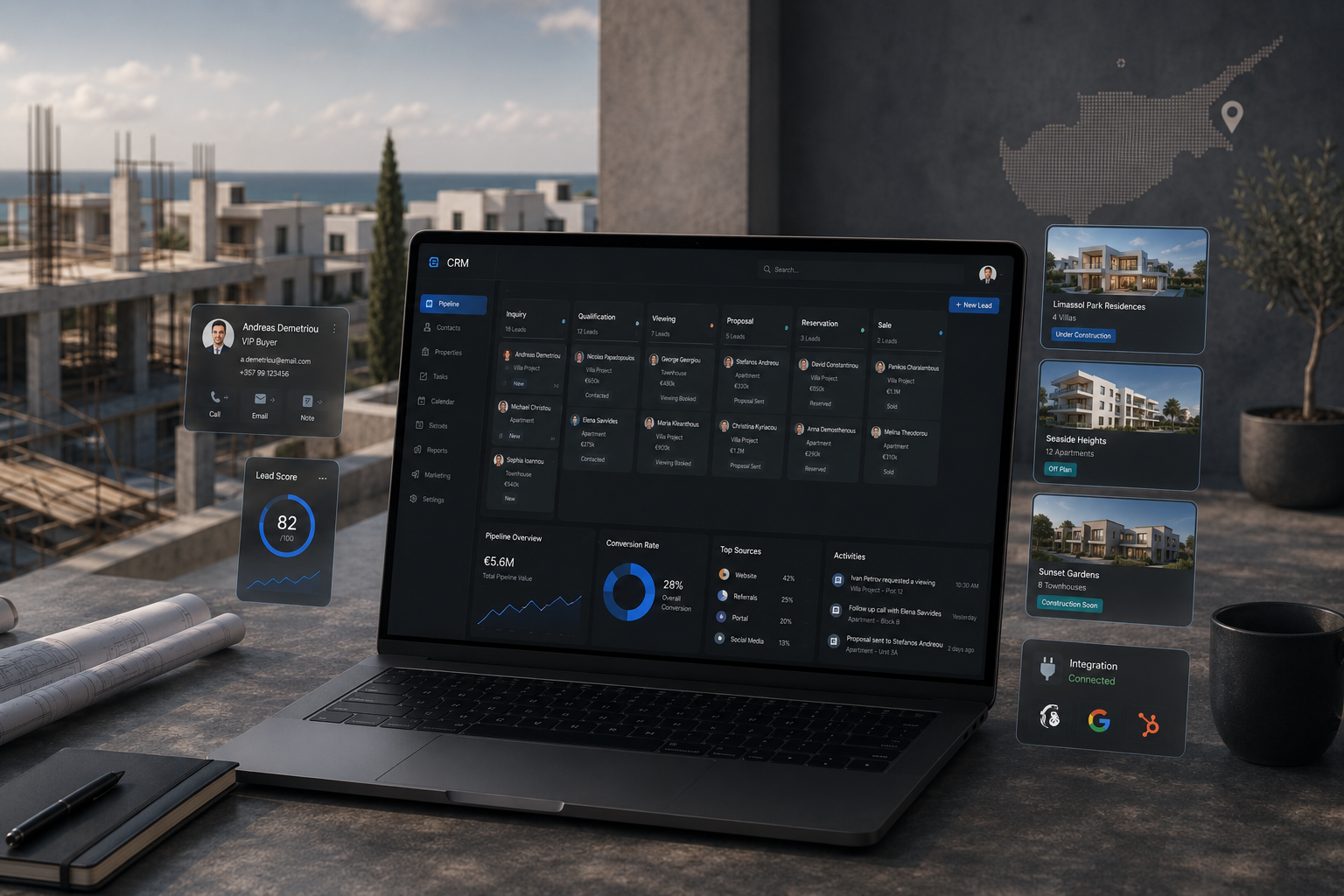
Quick answer: A real estate CRM gives developers and property businesses a structured way to manage buyer enquiries from first contact through qualification, viewing, proposal, reservation and sale. It can connect website forms, advertising leads, project interest, follow-up tasks and sales outcomes into one pipeline.
For property developers in Cyprus, this matters because the sales journey is rarely immediate. A buyer may discover a development through Google, Meta advertising, a property portal, a referral or an organic search, request information, compare projects, arrange a viewing and continue the conversation over several weeks or months.
Without a structured CRM, that journey can become fragmented very quickly.
Why real estate needs more than a contact list
A basic contact database can tell you who someone is. A useful real estate CRM should also tell you what they are interested in, where the enquiry came from, what has already happened and what needs to happen next.
For a developer with several active projects, that may include:
- preferred project or location;
- property type;
- budget range;
- local or international buyer status;
- lead source;
- assigned salesperson;
- last contact date;
- next action;
- viewing status;
- proposal or reservation status.
This creates a much more useful commercial picture than a spreadsheet of names and telephone numbers.
A practical real estate sales pipeline
The exact stages should match the developer’s sales process, but a property CRM might use a pipeline such as:
- New Enquiry — the lead has just entered the CRM.
- Contacted — a salesperson has made initial contact.
- Qualified — budget, project interest, timing and other key criteria are understood.
- Viewing Booked — an in-person or remote viewing has been arranged.
- Viewing Completed — the prospect has seen the development or unit.
- Proposal / Negotiation — commercial terms or unit options are being discussed.
- Reserved — the buyer has reached the reservation stage.
- Sold — the opportunity has completed successfully.
- Lost / Nurture — the opportunity did not proceed now but may require future follow-up.
The value of defining stages is consistency. Everyone in the sales team should mean the same thing when they say a lead is Qualified or Reserved.
Connect buyer enquiries to specific projects
A developer with several active developments needs to know which projects are generating demand.
The CRM should therefore capture project interest at the lead or deal level. Depending on the business, that could include the development, unit type, unit number, bedroom count, price range or preferred area.
This makes reporting considerably more useful. Instead of seeing only total enquiries, management can compare demand by project and buyer segment.
Track where property leads come from
Real estate marketing usually combines several acquisition channels. A CRM should preserve source information wherever technically possible.
Typical sources include:
- Google organic search;
- Google Ads;
- Meta Ads;
- website project pages;
- property portals;
- direct enquiries;
- referrals and partners;
- email campaigns;
- events or offline activity.
This is essential if the developer wants to move beyond cost-per-lead reporting and understand which channels are contributing to qualified buyers, viewings, reservations and sales.
Website forms should feed the CRM directly
A modern property website should be part of the sales infrastructure rather than a standalone brochure.
Project enquiry forms can capture useful information and pass it into the CRM automatically. Depending on the developer, that may include preferred development, budget, buyer location, phone number, purchase timing or whether the enquiry is for investment or personal use.
At Create, website development, lead generation and CRM implementation can therefore be designed as one connected system.
Use automation without losing the human sales process
Real estate is relationship-driven, so automation should support the sales team rather than replace personal communication.
Useful CRM automations can include:
- instant internal notification when a new project enquiry arrives;
- automatic lead assignment;
- confirmation emails;
- follow-up task creation;
- viewing reminders;
- notifications when an opportunity has had no activity;
- nurture workflows for longer-term buyers;
- lead-source and project tagging.
The conversation, qualification, viewing and negotiation should remain appropriately human-led.
Real estate CRM reporting that actually matters
A CRM is most useful when it helps answer commercial questions.
For a developer, useful reporting can include:
- new enquiries by project;
- qualified leads by source;
- viewings booked and completed;
- pipeline value;
- conversion between pipeline stages;
- reservations and sales by source;
- average response time;
- lead aging and inactive opportunities;
- performance by salesperson or team.
Not every company needs every report. The system should focus on the decisions management actually needs to make.
Why CRM matters for off-plan developments
Off-plan property sales often involve a longer education and decision cycle. Buyers may request floor plans, availability, payment terms, location information and construction updates before they are ready to reserve.
A CRM gives the sales team a structured history of those interactions and makes it easier to segment prospects by development and buying stage.
This connects naturally with off-plan developer marketing, where the website, content, paid campaigns and sales follow-up all need to support the same project.
CRM inside Create’s real estate growth system
Our real-estate work treats CRM as one layer of a broader demand system rather than a separate software project.
The Kantou Developers case study demonstrates this clearly: website infrastructure, SEO, paid acquisition, forms, HubSpot CRM and analytics were connected so enquiries could enter a structured follow-up environment.
The Square One case study also demonstrates how CRM fits alongside website development, search, paid campaigns and broader real-estate marketing.
For developers, the objective is not simply to collect leads. It is to build a system capable of showing what happens between acquisition and sale.
Common CRM mistakes in real estate
Using one generic pipeline for every process
A developer sales pipeline should reflect property-specific stages. Generic labels can make reporting meaningless.
Failing to record project interest
If the CRM cannot identify which development or property a buyer is interested in, the data loses much of its value.
Tracking leads but not outcomes
Recording a lead source is useful, but the real value comes when qualification, viewing, reservation and sales outcomes are also maintained.
Over-automating communication
Property purchases are high-consideration decisions. Automation should keep the process organised, not replace genuine sales relationships.
No ownership or next action
Every active opportunity should have a responsible person and a clear next step.
Frequently asked questions
What is a real estate CRM?
A real estate CRM is a customer relationship management system configured to manage property enquiries, buyer information, project interest, follow-up, viewings, proposals, reservations and sales activity.
Can a CRM manage multiple property developments?
Yes. A CRM can be structured to record project interest and report demand across several developments, provided the data model is configured correctly.
Can a real estate CRM track Google and Meta leads?
It can record lead-source information from website and advertising workflows where the relevant integrations and tracking are implemented. The exact level of automation depends on the platforms and CRM setup.
Is CRM useful for off-plan property sales?
Yes. Off-plan buyers often require longer follow-up and repeated information before reaching a reservation decision, making structured lead history and task management particularly useful.
Build the pipeline between marketing and property sales
If your development company is investing in marketing but buyer enquiries are still managed through disconnected inboxes or spreadsheets, CRM is the layer that can bring the sales process together.
Explore CRM Systems & Automation, our Lead Generation service, or request a quote.